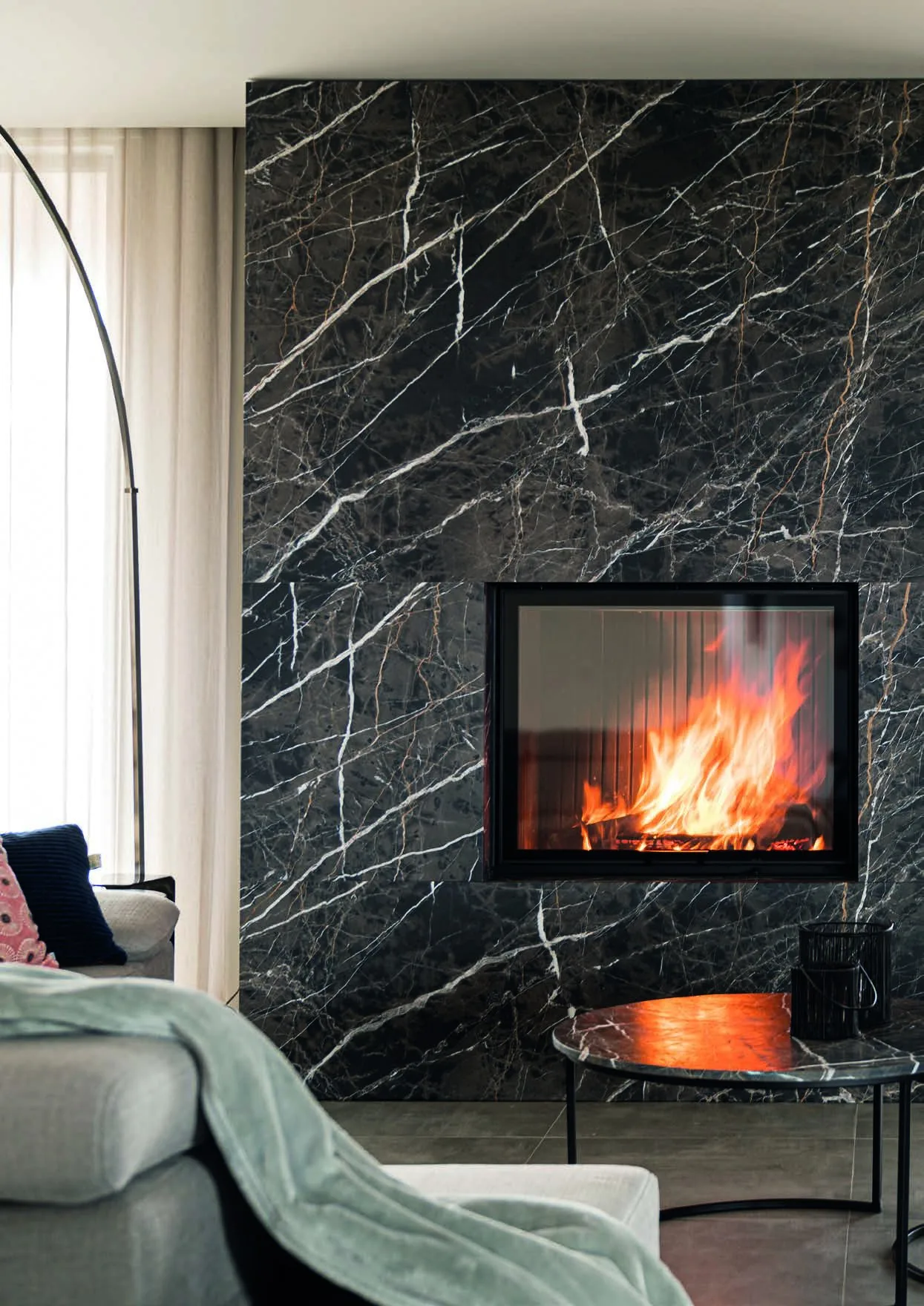
More warmth from your open fireplace: the fireplace cassette
An open fireplace is cosy, but it hardly warms the room. With a fireplace cassette you keep your fireplace and turn it into a fire that really heats. Our explainer film (in German) shows how the cassette works, what changes for you and how it is installed – with chapters to jump to directly and controls to try out.
An open fireplace is cosy, but it hardly warms the room. With a fireplace cassette you keep your fireplace and turn it into a fire that really heats. Our explainer film shows how this works and how the cassette gets into your fireplace. Above the film you can switch to the interactive version. There you set the size of your fireplace opening, switch between open fireplace and cassette and look at the shapes from above and from the front.
The film is in German with German subtitles. Below you will find the most important points in English.
Beautiful, but hardly warm
An open fireplace basically works like a campfire in the living room. The wood burns freely, and most of the heat goes up the chimney with the smoke. It also needs a great deal of air: for an opening of 75 by 55 centimetres, the planning rules assume around 150 cubic metres per hour, which is more than twice all the air in a normal living room. This air is already warm when it flows into the fireplace, and the room then lacks it. Cool air is drawn in through windows and doors, so you are warm at the fireplace and cold at your back.
In addition, the German Federal Immission Control Ordinance only allows open fireplaces for occasional use. Anyone who wants to sit by the fire regularly needs a closed fireplace.
What is a fireplace cassette?
A fireplace cassette is a closed steel insert with a glass door that is installed in the firebox of your existing fireplace. It is made to measure and adapts to the opening, not the other way round. Your fireplace usually stays as it is, and only the front with the glass is new. It is available for almost any shape:
- Glass at the front only: the classic shape
- Corner: glass at the front and on one side
- Three-sided: glass at the front and on both sides
- Curved glass: rounded glass, curving forward
- Round arch: rounded at the top
- Tunnel: the fire can be seen from two rooms.
An old cassette can also be replaced. For many older models there are successors that fit exactly into the same opening.
How the cassette works
- Air as needed: The fire gets exactly as much air as it needs. Part of it flows from below into the bed of embers, another part comes in at the top and sweeps along the glass. This ensures good combustion and keeps the glass clear for longer.
- Baffle plate: Above the fire, the hot flue gases have to take a detour. In doing so they give off more of their heat to the cassette before they rise into the chimney.
- Steel jacket: Cool room air flows in through the grille at the bottom, warms up on the hot firebox and rises back into the room at the top as warm air.
- Radiation: On top of that comes the heat through the glass, which you feel directly on your skin. The cassette therefore warms in two ways at once.
What changes for you
The difference is considerable. According to the manufacturers' industry association, a cassette raises the efficiency to four to five times that of an open fireplace, and modern cassettes reach around 80 per cent on the test bench. You therefore need considerably less wood for the same heat, and the heat stays in the room. The cassette also needs only a fraction of the air, so the draught at floor level is noticeably reduced. Sparks and embers stay behind the glass, and the smoke stays in the firebox.
Because the cassette is a closed fireplace, the "occasional use only" limit no longer applies to it. You may use your fireplace as often as you like, as long as the door stays closed while heating.
Precision work from measuring to final inspection
- Chimney sweep: Before we order a cassette, we talk to your chimney sweep. The chimney is swept and checked for its condition and tightness, because a cassette burns hotter than an open fire. The chimney and fireplace must be able to withstand this higher load safely.
- Measuring: We measure the width, height and depth of the opening, the shape of the firebox and the lintel above it. We also allow for the insulation that goes on the firebox walls during installation, because it makes the space for the cassette a little smaller.
- Hood: A look at the hood above the firebox and how it is built is just as important. The open fireplace becomes a warm-air fireplace, and this creates different temperatures in the hood than before.
- Installation: An existing damper at the top of the fireplace is fully opened and fixed in place or removed. The cassette is then pushed in and aligned, and all gaps around it are sealed tightly so that no stray air gets in. Because the hood now warms up differently, our installers from 369 Vision Werk usually open the fascia at the top and fit an air grille. This way the heat reaches the room as warm air and does not build up in the hood.
- Final inspection: As with every fireplace, the chimney sweep finally inspects the installation and approves it.
Heating correctly with the cassette
- Door closed: The door stays closed while heating. To add wood, open it slowly, just a crack at first, so the smoke keeps rising and does not enter the room.
- Add wood onto the embers: It is best to add wood when only embers are left in the firebox, and then a few logs rather than too many at once.
- Keep the grilles clear: The ventilation grilles at the top and bottom of the fireplace must always stay clear, otherwise heat builds up in the cladding.
- Dry wood only: Burn only dry, untreated firewood with a residual moisture of no more than 20 per cent, or wood briquettes. How to store and measure wood is explained in our guide Storing firewood.
- Distance from the glass: Nothing flammable may stand in the radiation area in front of the glass. The rating plate of your cassette states how large this distance is.
- Extractor hood and ventilation: The cassette takes its air from the room. If an extractor hood or a ventilation system runs at the same time, this must be safeguarded. Our film Stoves in airtight houses shows more about this.
Your next step
Feel free to take a few photos of your fireplace and roughly measure the opening. Bring them to our showroom in Ausbüttel or upload everything in the contact form, and we will plan the right cassette with you. You can book an appointment directly online.
Efficiency, output, distances and features depend on the model and are stated in the data sheet and on the rating plate of the cassette. The comparison "four to five times" comes from the HKI industry association. Short answers can be found under Frequently asked questions.